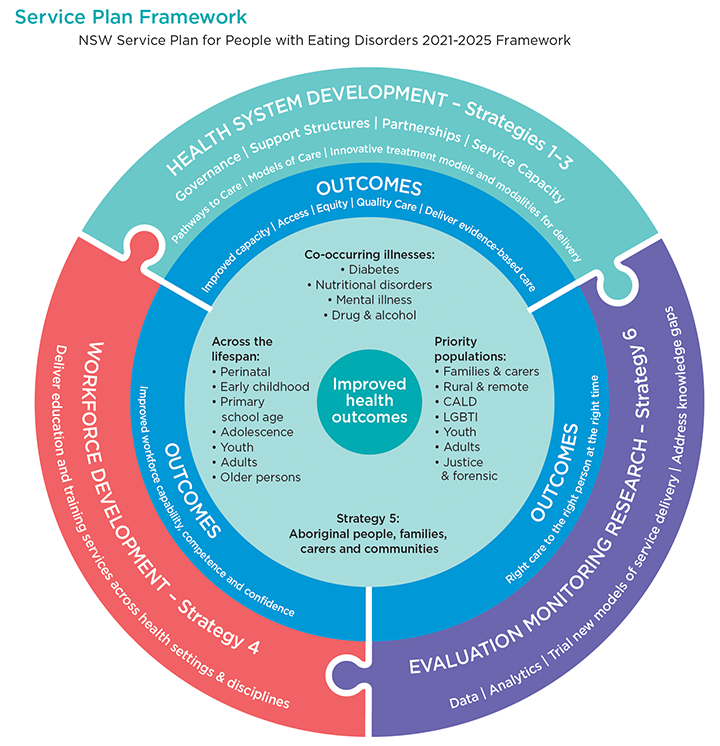
This Service Plan, to be implemented over five years, will continue to build and progress on the foundations that were set in the initial Service Plan. It aims to improve health outcomes, improve access to care; improve the quality of care and deliver efficient and effective care.
The Service Plan aims to embed eating disorders service provision as core business for Local Health Districts and Speciality Health Networks and will continue to build workforce capacity and strengthen pathways to care across the continuum of eating disorders treatment.
The Service Plan requires a whole of health reform, driven centrally and implemented locally, to prepare and equip the NSW Health system to identify, provide access to, and treat people with eating disorders.
This Service Plan has enabled the development of new hospital and community services for eating disorders – the single largest and most ambitious eating disorder clinical redesign ever undertaken nationwide.
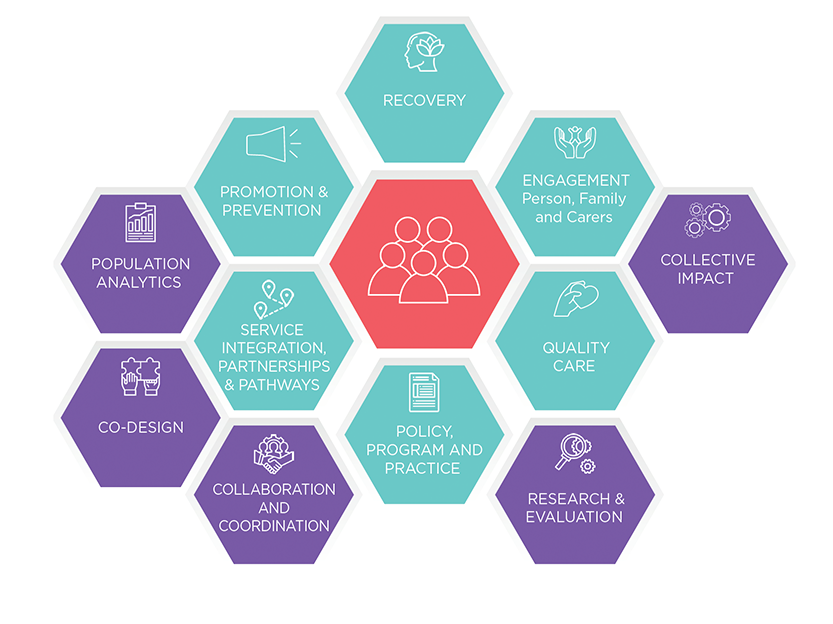
The Service System Framework is described in more detail in the blueprint for Action document. This underpins how the Service Plan will deliver on its key priorities and strategies.
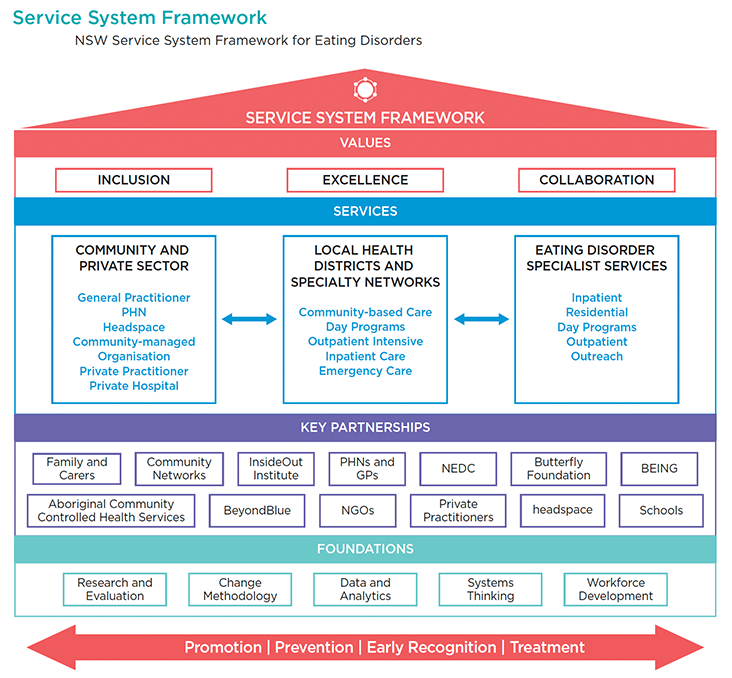
The blueprint for Action should be read in conjunction with this document. It outlines the rationale, the service development to date, the identified gaps, and detail for the development of priorities and strategies for the Service Plan.
The NSW tertiary hubs are expert centres for the treatment of eating disorders. As well as providing treatment services for the most severely unwell individuals and their families in NSW, these centres provide support to other services around the state that are providing treatment to people with eating disorders.
Their services include tertiary inpatient treatment, specialist outpatient clinics & day programs, outreach consultation for case management and training for clinicians and teams around the state.
The NSW Statewide Committee of Eating Disorder Medical Leads is responsible for providing advice and leadership for all matters related to the medical management and transition of patients with eating disorders in NSW, in line with the Service Plan.
The Medical Leads committee ensures that pathways for medical treatment for people with eating disorders exist locally. If you have questions directly relating to medical admission and treatment of people with eating disorders in your district, please raise these with your local eating disorder coordinator to be forwarded to the Medical Leads committee.
The NSW Service Plan sets out a major five‑year effort to strengthen eating‑disorder care across the health system, improving access, quality, and outcomes through better services, pathways, and workforce capability. This research evaluates how well service plan training boosts knowledge and confidence so programs can keep improving and inform government and sector-wide planning.
In Progress
The 2014 ‘Guidelines for the Inpatient Management of Adult Eating Disorders in General Medical and Psychiatric Settings in NSW’ provides valuable guidance for clinicians in services across the state in the care of a person with an eating disorder in a medical setting. InsideOut Institute in partnership with NSW Health and medical and psychiatric leads across the state have embarked on a full review and redesign of this guideline. The revised guidelines will reflect current evidence and best practice, provide consistent admission criteria, and ensure people with eating disorders can access the appropriate level of inpatient care across NSW.
In Progress
Dietitians play a crucial role in the care of a person with an eating disorder across the health system both in community and hospital settings. InsideOut Institute recognises the key role of Dietitians. However, the majority of the Dietitian workforce is within generalist roles rather than specialized positions. The upskilling project provides various NSW Health Dietitians with training opportunities through webinars, eLearning, Group Supervision, and a learning library. This equips Dietitians with the skills needed in the care and management of a person with an eating disorder, across the various roles and services within NSW Health.
In Progress
In the past 30 years there has been an increased awareness of the higher prevalence of disordered eating and eating disorders in people with and at risk of Type 1 Diabetes (T1D). The Queensland Eating Disorder Service (QuEDS) developed local guidelines for caring for people living with T1D, and an eating disorder or disordered eating. NSW Health formed a working group to review these guidelines, and explore adaptation and development of the guideline for NSW Health services, to provide guidance to clinicians working in the community with people with diabetes on how to assess and manage disordered eating and eating disorders. This guidance improves clinician confidence and ensures people with eating disorders and at risk of T1D receive coordinated, effective care.
In Progress
The NSW Service Plan emphasises having the Right People with the Right Skills in the Right Place. This highlights the need for a skilled, multidisciplinary workforce to support people with eating disorders across all levels of care. To achieve this, InsideOut efforts focus on building workforce Capacity and Capability across all NSW Health Services, providing NSW Health staff with training opportunities. This helps to ensure that individuals and their families receive high-quality, evidence-informed care close to home.
In Progress
This evidence‑based eLearning program supports dietitians working with children and adolescents with eating disorders in hospital settings. It provides guidance on nutrition management, intervention, review, education, and discharge planning, with practical activities and videos relevant across paediatric medical, mental health, and specialist settings. Developed by paediatric dietitians and people with lived experience, the course empowers dietitians and families as young people transition from hospital to community care. As a result, young people and their families can access evidence‑based support from inpatient dietetic services across NSW.
In Progress
A bespoke statewide workforce platform was developed to support clinicians, eating disorder coordinators and trainers with prerequisite learning, eLearning modules, and feedback collection. It allows coordinators to prioritise clinicians in their Local Health Districts and ensures access to current, evidence‑based training. Clinicians across NSW can now enrol in training that matches their needs and access training resources.
Complete
People with eating disorders can present in any healthcare setting. There is consensus that Dietetic Graduates are should be able to identify a person with an eating disorder and work safely with people with an eating disorder. However, training in Eating Disorders varies widely across universities. To address this, InsideOut established a national working party to review content at all universities delivering dietetics, and collaborated with NEDC to roll out a tertiary education programme focusing on prevention and identification, with pilot implementation at one NSW university, and plans for a standardized curriculum rollout across all NSW institutions by 2026/2027.
In Progress
Family-Based Treatment (FBT) is the recommended first-line therapy for young people with eating disorders, and efforts in NSW focus on expanding access to this care through workforce training. InsideOut Institute in collaboration with Prof Daniel Le Grange pioneered the development of a “train the trainer” model, enabling experienced clinicians to become FBT trainers and deliver education locally. Experienced clinicians were provided with extensive training by Daniel Le Grange to become trainers in FBT. This approach increases training accessibility, strengthens the workforce, and ultimately allows more young people and their families to receive evidence-based treatment close to home
In Progress
Across NSW, health services are increasingly involving people with a lived experience of an eating disorder and/or of caring for a loved one with an eating disorder in Service planning and improvement. This aims to ensure the skills, voices, experiences and contributions of those with a lived experience are effectively implemented, including Resources have been developed to support LHD Coordinators in meaningfully engaging these individuals.
In Progress
Across NSW, services report an increase in people presenting with Avoidant Restrictive Food Intake Disorder (ARFID), however, clinicians lacked access to evidence-based training to support them. To address this gap, an eLearning program, ARFID Fundamentals, was developed to provide clinicians with guidance on scope of practice across various healthcare settings. Co-produced with lived experience input, evidence informed and drawing on local and international expertise, the training helps clinicians understand ARFID, while differentiating from other feeding and eating disorders to enable a comprehensive assessment, and deliver multidisciplinary, person-centred care.
Complete
The Filling the blanks study aims to co-design a communication template that aligns with school and health practices to enhance consistent communication and care planning for school students in treatment for an eating disorder.
In Progress
Under development, coming soon!


© 2026 InsideOut
InsideOut acknowledges the tradition of custodianship and law of the Country on which the University of Sydney and Charles Perkins Centre campus stands. We pay our respects to those who have cared and continue to care for Country. We are committed to diversifying research and eliminating inequities and discrimination in healthcare. We welcome all people regardless of age, gender, race, size, sexuality, language, socioeconomic status, location or ability.