

© 2026 InsideOut
InsideOut acknowledges the tradition of custodianship and law of the Country on which the University of Sydney and Charles Perkins Centre campus stands. We pay our respects to those who have cared and continue to care for Country. We are committed to diversifying research and eliminating inequities and discrimination in healthcare. We welcome all people regardless of age, gender, race, size, sexuality, language, socioeconomic status, location or ability.
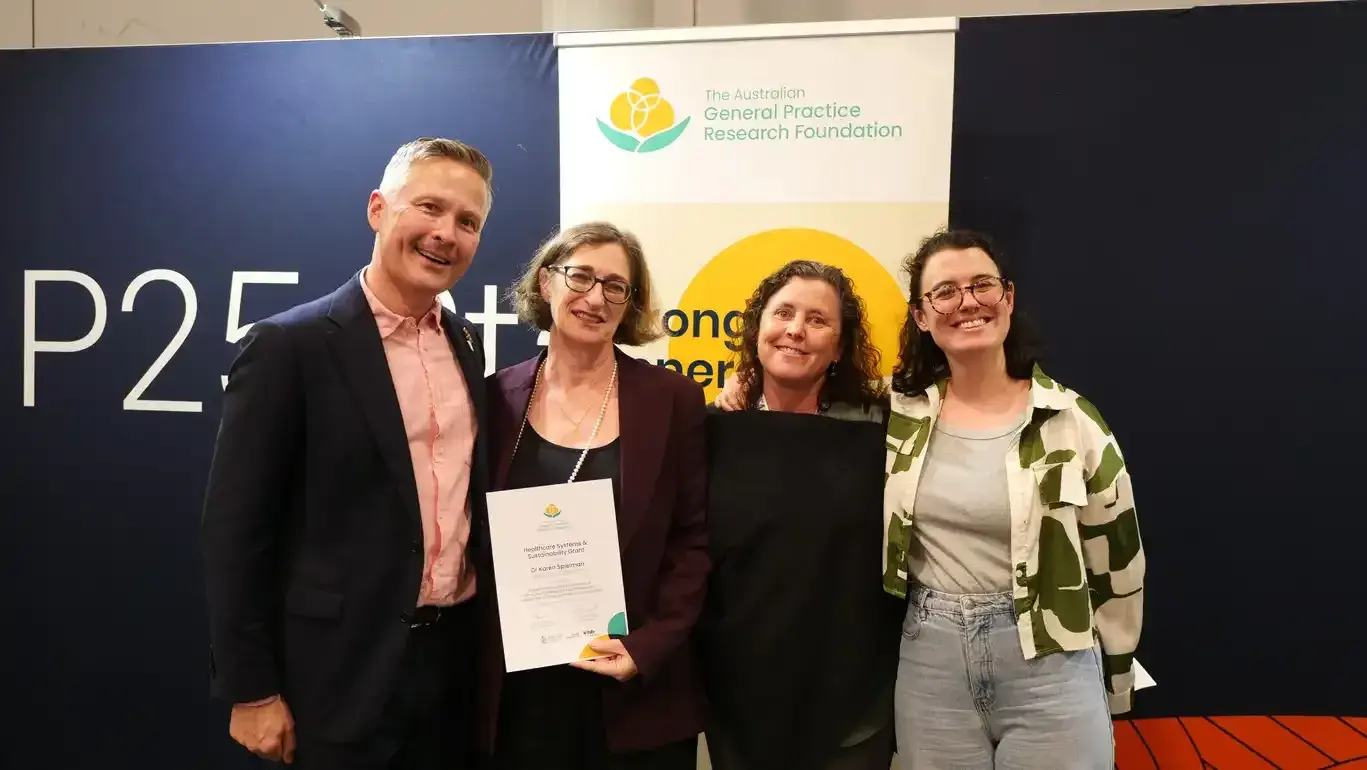
The InsideOut Institute team was delighted to be formally presented with the Healthcare Systems and Sustainability Grant Award at the RACGP’s GP25 conference. The Award, provided by the Australian General Practice Research Foundation, the philanthropic arm of the Royal Australian College of General Practitioners, is generously funded through the nib Group Foundation. InsideOut extends its sincere thanks for this essential support.
More than 1.1 million Australians are impacted by eating disorders, and binge-related conditions are the most common. Our project is centred on improving support for people with Bulimia Nervosa and Binge Eating Disorder, who too often face long waits or limited access to care, especially beyond specialist services.
The funded project, “Supported to Succeed: Evaluation of GP Supported Binge Eating eTherapy as a Scalable Low Intensity Primary Care Intervention,” aims to address this gap. Led by Dr Karen Spielman, with co-investigators Dr Sarah Barakat, Dr Kelly Dann, Dr Rachel Kalman, Ms Sally Corry, Dr Shu Ong, Professor Sarah Maguire and Ms Peta Marks, the $125,000 study will examine whether digital therapy prescribed and supported by GPs leads to higher engagement and improved outcomes.
Delivered through the InsideOut eClinic, the study will compare outcomes against matched historical controls and assess effectiveness, feasibility and acceptability using treatment data, participant surveys and qualitative interviews.
If shown to be effective, this GP-supported model has the potential to become a scalable first-line intervention for binge eating disorder in primary care. This would contribute to earlier detection, more timely treatment, and improved access to evidence-based care for people across Australia.