

© 2026 InsideOut
InsideOut acknowledges the tradition of custodianship and law of the Country on which the University of Sydney and Charles Perkins Centre campus stands. We pay our respects to those who have cared and continue to care for Country. We are committed to diversifying research and eliminating inequities and discrimination in healthcare. We welcome all people regardless of age, gender, race, size, sexuality, language, socioeconomic status, location or ability.
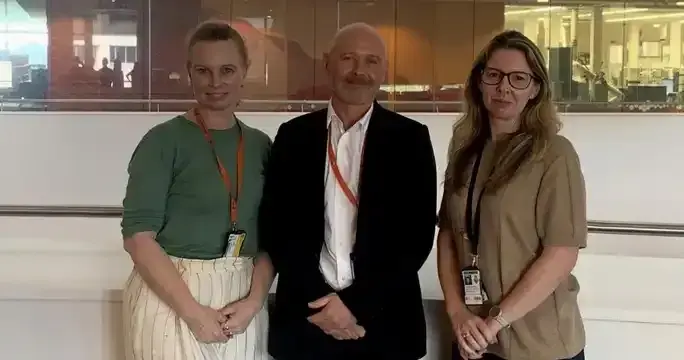
InsideOut Institute for Eating Disorders has been highlighted as an example of international best practice in a newly released Churchill Fellowship report by Stephen Watkins, Associate Non-Executive Director at Lancashire and South Cumbria NHS Foundation Trust (UK).
The report examines how Australia, New Zealand and Sweden have developed national strategies to address the eating disorders treatment gap, with the aim of informing future UK policy and service reform.
Drawing on extensive international consultations, the report positions Australia’s coordinated, strategy-led approach as a global leader, with the work of InsideOut Institute recognised as a key driver of innovation and implementation.
During his Fellowship, Mr Watkins spent a week embedded with InsideOut’s team in Sydney, observing first-hand how research, policy, workforce development and digital innovation are translated into practice.
The report highlights several InsideOut Institute initiatives, in partnership with federal and NSW government, as exemplars of effective system reform, including:
The report emphasises that these initiatives are not isolated projects, but part of a coordinated national and state strategy supported by governance, evaluation and sustained investment.
Mr Watkins concludes that many of the models developed by InsideOut Institute are directly transferable to the UK context, particularly in relation to digital therapies, workforce development, early intervention, and embedding lived experience into service design.
As policy briefings are now underway with UK governments, the report is intended as a practical “how-to” guide for building effective national eating disorder systems, and positions InsideOut Institute as a reference point for international learning and collaboration.