

© 2026 InsideOut
InsideOut acknowledges the tradition of custodianship and law of the Country on which the University of Sydney and Charles Perkins Centre campus stands. We pay our respects to those who have cared and continue to care for Country. We are committed to diversifying research and eliminating inequities and discrimination in healthcare. We welcome all people regardless of age, gender, race, size, sexuality, language, socioeconomic status, location or ability.
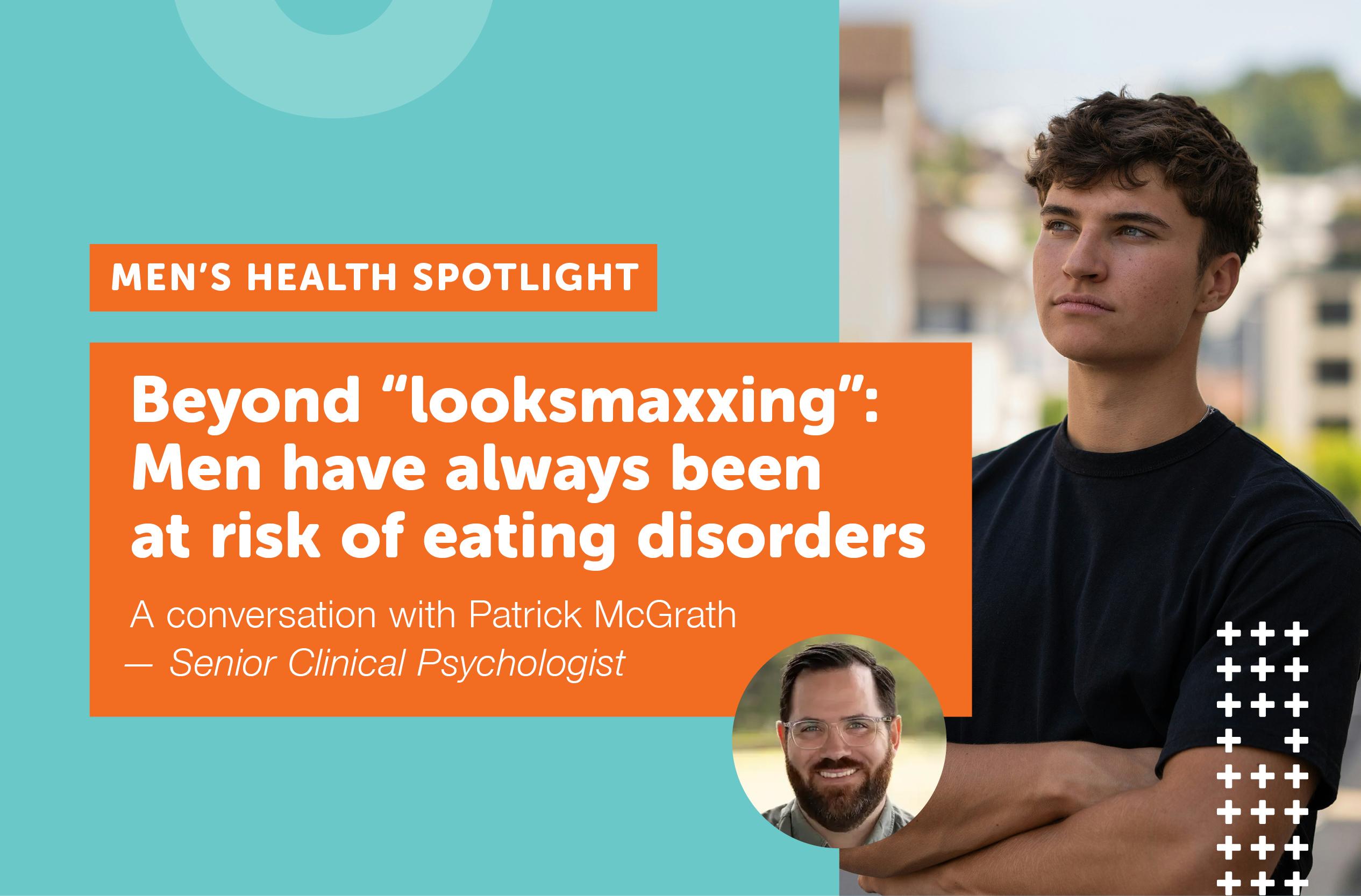
If you’ve spent any amount of time on social media lately, you’ve likely come across terms such as “looksmaxxing.” While these terms may seem like silly slang or a passing online trend, the ideas beneath them point to something more serious.
"Looksmaxxing" is an online movement centred around maximising your physical attractiveness; promoting the belief that physical attractiveness is the ultimate driver of social and personal success; and something that should be pursued at any cost. Proponents of this trend have popularised and promoted extreme and sometimes dangerous methods in pursuit of a particular aesthetic1.
“What was once confined to niche corners of the internet has now entered more mainstream discussion, fuelling a powerful trend that drives comparison and places one’s value solely on their appearance2. As a result, there is growing concern over the increasingly high and unrealistic physique expectations placed on men — for example, being extremely lean and simultaneously extremely muscular. While this has raised important conversations about body image, muscle dysphoria, and the increased risk of eating disorders, it is important to remember that eating disorders in men are also not a new phenomenon; and their presentations extend beyond an intense focus on aesthetics.
Much of the current conversation around these online trends and eating disorders attribute this increased risk to the hyperfocus on and intense pursuit of a particular look. While these trends do increase pressure for men to conform to a certain physique, they don’t tell the full story.
Eating disorders develop from complex psychological, emotional, and biological factors that go well beyond appearance3. Among men in particular, eating disorders are frequently underreported and underdiagnosed, with stigma, stereotyping and limited awareness acting as barriers that prevent men from seeking or gaining access to help and support4,5. While it is encouraging to see conversations around looksmaxxing highlighting the increased risk of eating disorders in men, it is important not to add to the stigma men face when seeking support by reducing this illness to mere aesthetics.
We sat down with Patrick McGrath, Senior Clinical Psychologist at InsideOut, to better understand what is missing from the conversation.
InsideOut Institute: There has been a rise in the discussion of trends such as "looksmaxxing" — what do these trends tell us about the pressures men are facing today?
Patrick McGrath: I think these trends make what was once perhaps an implicit pressure for men to meet certain ideals, much more explicit. Social media amplifies and intensifies comparison, and we’re seeing this comparison add additional pressures on men, and particularly young men.
These trends also narrow the criteria of what is considered “peak masculinity” and boils it down to being focussed solely on appearance, often centered very specifically around muscularity as the way to adhere to gender expectations.
Looksmaxxing capitalises on a broader ‘optimisation culture,’ framing aspects of people’s appearance as changeable or endlessly adjustable — even when they are not; bone structure is a common example. When people are unable to achieve these changes, they may see this as a personal failing rather than an unrealistic or unattainable ideal.
Looksmaxxing exists on a broad spectrum; from basic ‘appearance fixing’ components to behaviours that can be dangerous.
There has been an increasing representation of very muscular physiques in popular culture, as well as on social media. Combine that with the increase in the accessibility of substances like steroids and other supplements, there is increased pressure to conform to these unrealistic physical standards.
IOI: Much of the conversation around looksmaxxing focuses on men pursuing a particular aesthetic ideal, however concerns around men, eating, and body image are not new. How does the discourse around looksmaxxing unintentionally reinforce misconceptions about eating disorders in men, including the belief that they are always driven by appearance, muscle definition, or a desire to change how someone looks?
PM: For a long time, as a community, both the prevalence and seriousness of eating disorders in men has been under-estimated. This is likely related to stigma and stereotyping – because eating disorders are frequently seen as only occurring in women. It could also relate to the fact that, men’s concerns may be expressed differently – for example, they may be striving for a lean and muscular physique rather than wanting to lose-weight or being fearful of weight gain as is the common presentation. While the entry pathways into eating disorders might be different, the symptoms, underlying distress and required treatments are the same.
Undoubtedly this focus on muscularity is only representative of some experiences of eating disorders in men and doesn't capture the full breadth of how they can present.
It is important to note that men experience the full range of eating disorders, including Anorexia Nervosa, Bulimia Nervosa, Binge Eating Disorder, and Avoidant and Restrictive Food Intake Disorder (ARFID).
We’ve also long known that the prevalence of eating disorders varies across different groups of men. Gay and bisexual men6, as well as transgender and gender-diverse people, experience higher rates than their heterosexual and cisgender peers7.
IOI: What are some warning signs that someone may be struggling with disordered eating or an eating disorder? Are there any signs that are particularly specific to men?
PM: If you or someone you know is making significant changes to what they eat or allocating significantly more time to their appearance than is usual for them, it’s helpful to look for the warning signs.
It’s important to note that there is nothing inherently concerning about a person making changes to what they eat, or how they look. The relevant part is the distress they experience in the process of seeking to make these changes, and how flexible they can be when they have other important domains of their life to be allocating their energy to, whether that be social, romantic or family relationships, work or study.
Some warning signs to look out for would be:
IOI: Why do eating disorders in men continue to be under-recognised and under-diagnosed, despite growing awareness of men's mental health? What barriers can make it harder to seek support?
PM: Stereotypes, unfortunately, persist — eating disorders are still primarily seen as an issue for women and girls, which contributes to delayed detection in males. And while we’ve made great progress in raising awareness regarding mental health generally, especially in men, there is likely still additional stigma and shame relating to eating related issues that stops people from talking about it as much.
I would also note that behaviours like following a strict diet or exercising a lot can be perceived positively by others when framed as ‘discipline,’ or when it’s couched in fitness or health goals. This can make it more difficult to identify when these behaviours have become problematic, meaning the person may be struggling with these distressing thoughts and behaviours for a long time before other people notice that they’re not okay.
For some, social ties or a sense of community in gym or fitness environments can make it difficult to take a step back, giving up valued connections with other people, even when behaviours become problematic.
IOI: What are the risks of viewing eating disorders in men through the lens of body image, appearance, or fitness goals?
PM: We run the risk of marginalising those whose eating disorders are not understood through these frames of reference, as well as contributing to the idea that eating disorders are about ego or vanity, or even a choice. It also misses the genetic and biological drivers of illness for individuals, as well the complex emotional and psychological issues that people with eating disorders often experience.
IOI: What are you seeing in this space that gives you hope?
PM: As a society, we’re much more alert to the risk of eating disorders in men and boys, and particularly clinicians and researchers. This means that we are hopefully better equipped to offer support to more people, and earlier in the course of their struggle with eating and body-related concerns.
Treatment has never been more accessible than it is now in Australia with Eating Disorder Treatment Plans via Medicare subsidising face to face therapy sessions, and services like the InsideOut eClinic providing free, evidence based self-help options online to people in the privacy of their own homes.
There is also a lot of innovative research happening in eating disorders that mean we will continue to better understand eating disorders and hopefully have even more effective treatments available in future.
IOI: For men who may be struggling with food, exercise, body image, or appearance-related concerns, what would you like them to know?
PM: If you’re finding that food, exercise, or appearance is taking up more mental space that you’d like, you’re not alone, and change is possible.
You don’t need to wait until things feel “serious enough” to ask for help. If it’s causing you distress and impacting your life, that’s reason enough. Talking to someone you trust in your life, or a professional such as a GP, a service like headspace, or the Butterfly Foundation’s National Helpline (1800 334 673) can be an important first step.
This is not something you have to struggle with alone, help is available, and recovery is possible.